SEO vs. AEO vs. GEO — What’s the Difference?

Updated: Dec 28, 2025
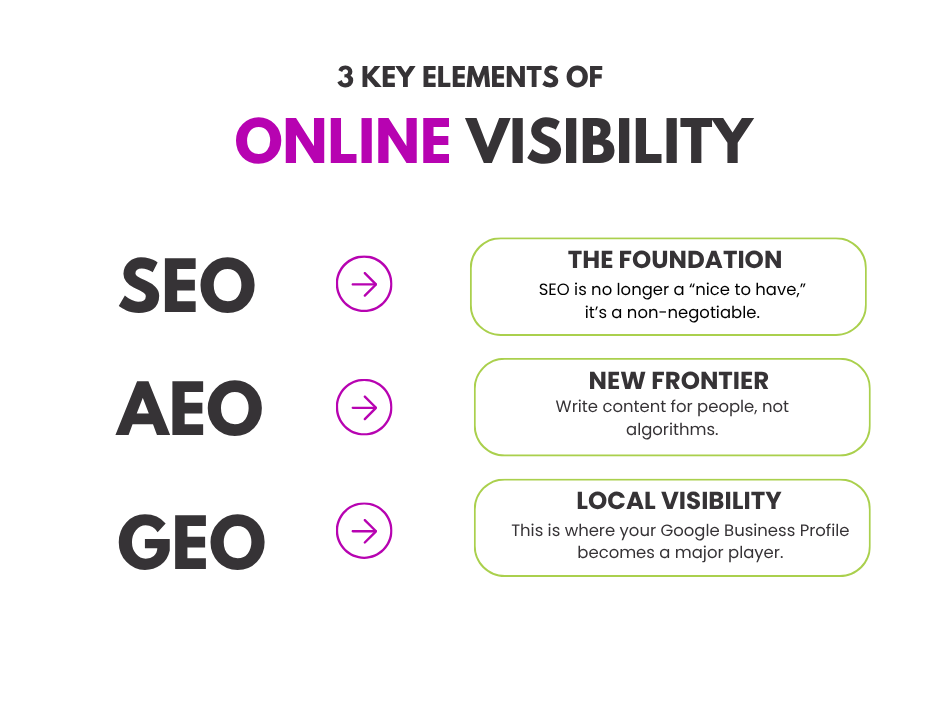
If you’ve been in digital marketing for any amount of time, you already know that SEO is no longer a “nice to have” — it’s a non-negotiable. But the landscape is shifting faster than ever, and ranking on Page 1 is only one piece of the puzzle. Today, visibility depends on whether your brand can appear in search results, AI responses and local intent moments simultaneously.
That’s where SEO, AEO and GEO each play a role — and understanding how they work together is exactly how brands stay relevant in 2025 and beyond.
SEO (Search Engine Optimization): The Foundation
SEO is your long-term visibility engine. It’s how you tell Google, “this content matters,” and convince users to actually engage with it. Traditional SEO focuses on:
Creating content that meets search intent
Optimizing metadata, headings and structure
Improving site speed, mobile experience and technical health
Building authority through internal and external links
SEO isn’t just about keywords anymore — it’s about proving value. Google now evaluates expertise, trustworthiness, page experience and how helpful your content is. That means your SEO strategy can’t simply be about stuffing keywords on a page; it has to solve real problems, earn engaged clicks, and build credibility over time.
SEO is still the backbone of any digital strategy — but it doesn’t live alone anymore.
AEO (Answer Engine Optimization): The New Frontier
Enter the age of AI-driven search. From Google’s AI Overviews to tools like ChatGPT, Perplexity and voice assistants, users are now asking questions and expecting clear, instant answers.
AEO is all about training your content to be the answer. Instead of writing long, fluffy paragraphs that make users hunt for information, AEO requires:
Direct, concise answer statements
Question-based headings
Structured content (FAQs, lists, definitions)
Schema markup (especially FAQ, How-To, Product and Local Business schema)
Genuinely helpful information written in natural language
AI tools and voice assistants don’t want marketing fluff. They want clarity — and AEO pushes brands to deliver just that.
The companies that win in this space will be the ones who write content for people, not algorithms.
GEO (Geolocation Optimization): Your Local Visibility Powerhouse
Now let’s talk local — the area where most businesses either shine or completely miss the mark.
GEO focuses on helping you show up when someone searches:
“near me”
“in [city]”
“best [service] in [location]”
“open now”
This is where your Google Business Profile becomes a major player. Local pages, reviews, service areas, NAP consistency (name, address, phone) and category selection all influence how — and where — you appear in local results.
If SEO gets you on Google, GEO gets you in front of the people who are actually ready to buy.
In 2025, local search in Calgary and nearby communities is exploding. Users rely on maps, directories, and proximity-based search results more than ever. If your business serves a geographic area, GEO isn’t optional — it’s the engine that brings qualified leads right to your door.